The Honest Week (How Halo Decides What You Lift Next)
hard sets, real plates, no ego.
You’ve probably done 3 sets of 10 for as long as you’ve lifted.
Somebody showed it to you once, and everyone around you does it too.
Same weights as last month. Same machines, in the same order. The leg day you skip when you’re tired. The calves you’ve never trained once.
And on the one day you felt strong, you put another 10 kg on the bar, felt something pull, and spent the next week walking it off.
Sound familiar?
All of that comes from training without a plan.
A good week is boring on purpose. Hard sets. A floor for every muscle. Add a rep, then add the smallest weight you can. Check it every Saturday against what you actually did.
We call it the Honest Week, and this is the rule book Halo’s training engine runs on.
It’s our first version. We learn from every week people train with it, and we keep improving it.
Every number below links to the study it came from. Where a number is our own call, we say so.
Count hard sets
What builds muscle is the number of hard sets you do each week.
A hard set is one you finish with one to three reps still in you. Going all the way to failure buys almost nothing extra for growth,1 and for strength it didn’t matter either way.2 Getting close does matter for size. Growth rose as sets ended nearer failure.3
The catch is that people are bad at guessing how many reps they have left, and better at it closer to failure, with heavier loads and in later sets.4 That’s why a new lifter starts with three in reserve. If the guess is off, it’s off in the safe direction.
The weight on the bar matters less than you think. Muscle grows on heavy loads and light ones, as long as the sets are hard.5 Strength is pickier: heavier loads won there.6 So Halo gives each kind of lift its own range:
- Squats, deadlifts, bench – 6 to 10 reps for muscle, 3 to 6 for strength, never all the way to failure.
- Machines and dumbbells – 8 to 12, a little closer to the edge.
- Curls, raises, calves – 10 to 20, and the last set can go near failure, because nothing bad happens when a curl stalls.
Every muscle gets a floor
Growth follows the number of hard sets a muscle gets each week.
Each extra weekly set added roughly 0.37% to muscle growth.7 Across 67 studies, more sets kept helping, but each one added a little less than the last.8 The latest ACSM position stand puts the line for growth at 10 or more sets a week,9 and in trained people 12 to 20 looked like the sweet spot.10
And when time is tight? A minimum of 4 sets per muscle a week still works.11
That 4 is the number we built the floor on.
Think of your body as a skill tree. You don’t get to level up by skipping the nodes nobody posts about.
Calves get a floor. Side delts get a floor. Biceps, triceps, abs, rear delts get a floor. Grip gets two sets. Neck is off unless you ask for it.
To be straight with you: no study has set a weekly dose for forearms or obliques. Those floors are our call, built on that minimum of 4 and kept small on purpose.

Calves even come with instructions. Three sets of 15 to 20, with the heel sinking deep at the bottom, grew the calf more than full-range or top-half reps did.12 So that’s how Halo writes them.
Short on time? The small muscles go into the rest between your heavy sets, or in pairs, a curl and a pushdown back to back. Supersets roughly halve the time for the same work.11
Small steps beat big jumps
Here’s the kicker: most people go up too fast, because the plates lying around are 5s and 10s. Last week’s 60 becomes 70, and the reps fall apart.
The smallest real step on a barbell is 2.5 kg, a 1.25 kg plate on each end. A pin stack moves in 5. Dumbbells usually jump by 2. Kettlebells usually jump by 4. Gyms in pounds move in 5 lb.
So Halo knows what your equipment can actually make, picks the smallest step it has, and only takes it once you’ve earned it.
Next weight = the next one your gym actually has.
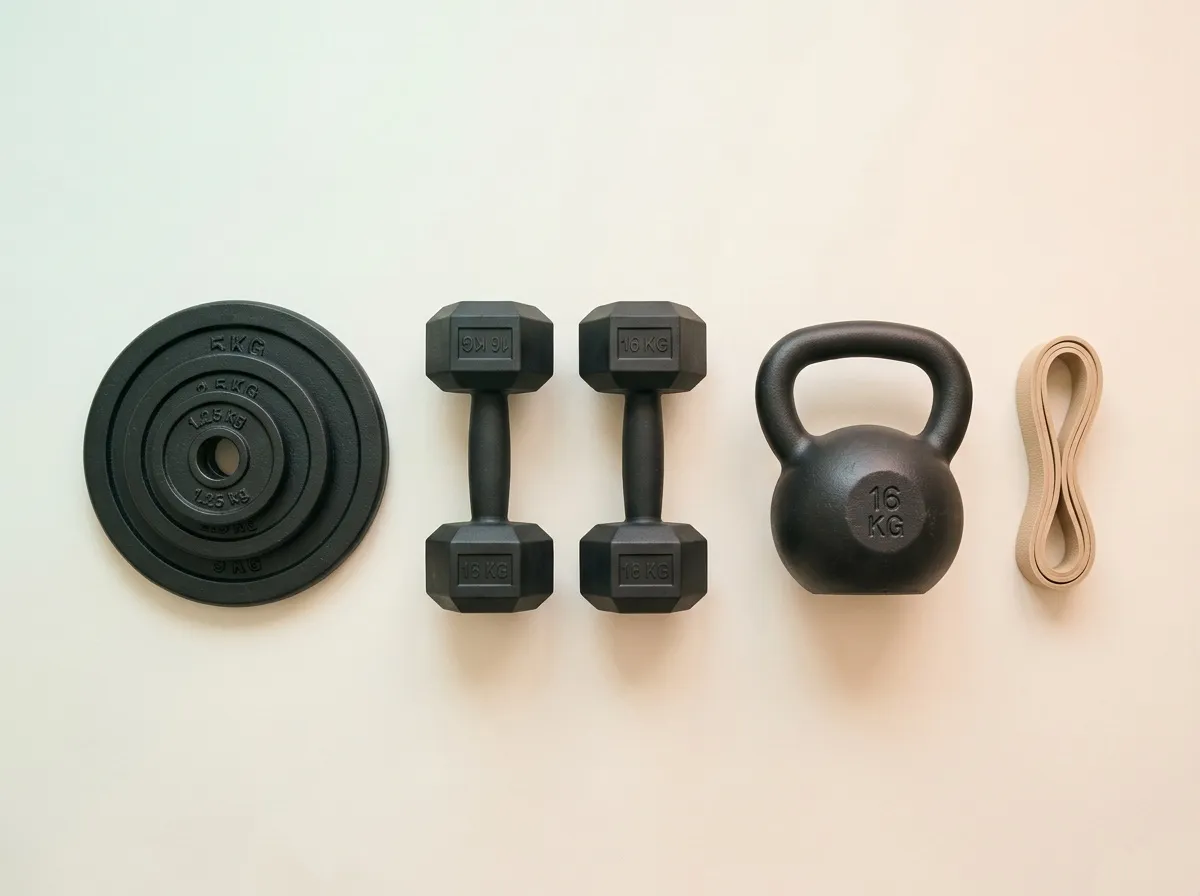
Small weights need one more rule. ACSM’s guidance is to add 2 to 10% once you beat your target by a rep or two.13 Going from a 6 kg to an 8 kg dumbbell on lateral raises is a 33% jump.
Too much.
So when the next real step is bigger than 10%, Halo stretches the rep range first, say from 12 to 20, and only moves up when you own the top of it.
Reps are kept to normal numbers too: 5, 6, 8, 10, 12, 15, 20.
Reps first, then weight
This is double progression, and it’s about as unglamorous as training gets.
You get a range, like 3 sets of 8 to 10. You add a rep where you can. When every set hits 10, the next session adds the smallest real step and you start again at 8.
Adding reps and adding load both worked over 8 weeks, with reps slightly ahead for size and load slightly ahead for strength.14
Hard sets lead to more reps.
More reps lead to more weight.
More weight makes the sets hard again.
That’s the whole engine. Everything else is guardrails.
Start light, and let the first session tell the truth
Nobody can predict your bench from your body weight.
Two people lifting the same share of their max can manage very different numbers of reps.15 Any formula that guesses your starting weight will be wrong for someone, and it will usually be wrong in the risky direction.
So Halo starts you deliberately light, then asks one question after each set: how many more could you have done?
- Way too easy – up two steps.
- A bit easy – up one.
- About right – stay.
- Too hard – down one.
Two sessions that land on target and the lift is calibrated. From then on your own logs set the weight.
“But I’m stronger than that.”
Good. Then it’ll take you two sets to prove it.
The caps Halo won’t cross
Ego lifting is how people get hurt, and it’s boring as hell to come back from. So the engine has caps it won’t cross, however good one set looked.
- Weekly jumps – no more than about 5 to 10%, inside ACSM’s 2 to 10%.13
- Typos – a set that suddenly says you’re 15% stronger is held until you confirm it. Usually it’s a fat thumb.
- First 8 weeks – no sets under 5 reps, and no max tests.
- Time off – strength fades with the length of a break, and more in people over 65.16 So you come back lighter: 10% off after a week or two away, and a fresh start after two months.
- Pain – for long-standing aches, some pain during exercise needn’t stop progress.17 Above a 3 out of 10, the lift holds. Above a 5, or worse the next morning, it swaps to a gentler version.
The good news hides in the same research. Muscle comes back fast: people who took three weeks off every nine ended up with similar growth after six months as people who never stopped.18
And some things aren’t ours to coach. Chest pain, numbness, a hard fall. Halo stops the plan and suggests you see someone who can examine you.
Rest is part of the set

Three-minute rests beat one-minute rests for both strength and size in trained men.19 For growth, resting longer than 60 seconds helped, and going past about 90 added little.20
So heavy lifts get 2 to 3 minutes. Curls and raises get 60 to 90 seconds.
Then Halo looks at what really happens. If you keep waiting ten minutes for the same machine, the plan should stop pretending you don’t. It offers the same movement on equipment that’s usually free, moves the lift, or pairs the wait with a set of something small.
Saturday night, the week rewrites itself
Every Saturday, Halo reads your week and runs seven checks, in the same order every time.
Missed a few sessions? Nothing changes the first week. Under 60% for two weeks running, Halo offers one fewer day, with the same floors spread across the days you do make. It turns out that’s fine: with the same weekly sets, training a muscle once, twice or three times a week grew it about the same.21
The plan bends to the week you’re actually living.
And one change per lift per week, so next Saturday can tell what worked.
Do the hard sets.
Leave two in the tank.
Load what’s real.
Train the small stuff.
Come back Saturday.
Thank you for reading.
– The Halo team

Get a week built like this.
Halo plans your sets, reps and weights, and adjusts them each week from what you actually lifted. Coming to iPhone.
Sources
- Refalo et al., 2023. Influence of resistance training proximity-to-failure on skeletal muscle hypertrophy. doi.org/10.1007/s40279-022-01784-y
- Grgic et al., 2022. Resistance training to failure or non-failure: strength and hypertrophy. doi.org/10.1016/j.jshs.2021.01.007
- Robinson et al., 2024. Estimated proximity to failure, strength gain and muscle hypertrophy: meta-regressions. doi.org/10.1007/s40279-024-02069-2
- Halperin et al., 2021. Accuracy in predicting repetitions to task failure in resistance exercise. doi.org/10.1007/s40279-021-01559-x
- Schoenfeld et al., 2021. Loading recommendations for muscle strength, hypertrophy, and local endurance: the repetition continuum. doi.org/10.3390/sports9020032
- Lopez et al., 2021. Resistance training load effects on muscle hypertrophy and strength gain. doi.org/10.1249/MSS.0000000000002585
- Schoenfeld et al., 2017. Dose-response relationship between weekly resistance training volume and increases in muscle mass. doi.org/10.1080/02640414.2016.1210197
- Pelland et al., 2026. The resistance training dose response: meta-regressions on weekly volume and frequency. doi.org/10.1007/s40279-025-02344-w
- Currier et al., 2026 (ACSM position stand). Resistance training prescription for muscle function, hypertrophy, and physical performance in healthy adults. doi.org/10.1249/MSS.0000000000003897
- Baz-Valle et al., 2022. A systematic review of the effects of different resistance training volumes on muscle hypertrophy. doi.org/10.2478/hukin-2022-0017
- Iversen et al., 2021. No time to lift? Designing time-efficient training programs for strength and hypertrophy. doi.org/10.1007/s40279-021-01490-1
- Kassiano et al., 2023. Greater gastrocnemius muscle hypertrophy after partial range of motion training at long muscle lengths. doi.org/10.1519/jsc.0000000000004460
- ACSM, 2009. Progression models in resistance training for healthy adults. doi.org/10.1249/MSS.0b013e3181915670
- Plotkin et al., 2022. Progressive overload without progressing load? Load or repetition progression. doi.org/10.7717/peerj.14142
- Nuzzo et al., 2023. Maximal number of repetitions at percentages of the one repetition maximum. doi.org/10.1007/s40279-023-01937-7
- Bosquet et al., 2013. Effect of training cessation on muscular performance: a meta-analysis. doi.org/10.1111/sms.12047
- Smith et al., 2017. Should exercises be painful in the management of chronic musculoskeletal pain?. doi.org/10.1136/bjsports-2016-097383
- Ogasawara et al., 2012. Muscle hypertrophy after 6 months of continuous and periodic strength training. doi.org/10.1007/s00421-012-2511-9
- Schoenfeld et al., 2016. Longer interset rest periods enhance muscle strength and hypertrophy in resistance-trained men. doi.org/10.1519/JSC.0000000000001272
- Singer et al., 2024. Give it a rest: inter-set rest interval duration and muscle hypertrophy. doi.org/10.3389/fspor.2024.1429789
- Schoenfeld et al., 2019. How many times per week should a muscle be trained to maximize muscle hypertrophy?. doi.org/10.1080/02640414.2018.1555906
Halo is not a medical device and does not give medical advice. If you’re pregnant, injured or returning from surgery, check with the people looking after you first.